 Surprise Mold Removal
 Black Mold Removal in Surprise, AZ
Found black mold in your Surprise home? Here’s the honest version most mold companies won’t lead with: the color of the mold matters far less than the moisture feeding it, and “black mold” is not an emergency surcharge. It’s a mold colony that needs proper containment, removal, and clearance testing like any other. Safe removal falls in the same published price ranges as standard remediation, and what you’re looking at may not be Stachybotrys at all. Most of the time, it isn’t.
What black mold actually is
“Black mold” almost always refers to Stachybotrys chartarum, a greenish-black mold that grows on chronically wet cellulose: the paper facing of drywall, wood, cardboard. Two things make it distinctive:
- It needs sustained saturation. Stachybotrys doesn’t grow from ambient humidity or a splash. Finding it means the material stayed soaked for a week or more: a slow supply-line leak, a chronic roof leak, a condensate drip inside a wall. It’s a reliable flag that there’s a long-running moisture problem, which is the real finding.
- It’s heavy and slimy. Unlike dusty molds, its spores don’t easily go airborne while it stays wet and undisturbed. The dangerous moment is uncontained disturbance, which is exactly why ripping out the wall yourself, or hiring a crew without HEPA negative air, is the worst move available.
Meanwhile, plenty of black-colored growth in Surprise homes is Cladosporium or Aspergillus (genuinely common here, especially around AC vents and window sills) or plain shower mildew. Only lab testing tells you the species. Testing is available, but often it won’t change the plan: any established indoor colony gets removed the same careful way.
The fear-pricing problem: worse in Arizona
Arizona has no state mold license. Combine an unregulated market with two decades of “toxic black mold” headlines and you get a predictable scam pattern in the Valley: a free “inspection,” a flashlight pointed at dark staining, the word Stachybotrys said gravely, and a quote two or three times the fair price with pressure to sign today.
Reference points to defend yourself with: Phoenix-area remediation averages about $1,800 and most jobs fall between $1,500 and $6,500, regardless of species, because the S520 process doesn’t change based on the mold’s name. Containment is containment. If a bidder’s number jumped because the mold is black, get another bid. A fair bid is on paper, itemized, and tied to the square footage of contamination, not the color.
How black mold should be removed
The process follows the same ANSI/IICRC S520 standard as any mold remediation, with a few points of extra discipline given how Stachybotrys behaves when disturbed:
- Moisture source confirmed first. Stachybotrys means long-term water. If the leak isn’t found and fixed, removal is temporary. The moisture gets mapped with meters and thermal imaging before anything is scoped.
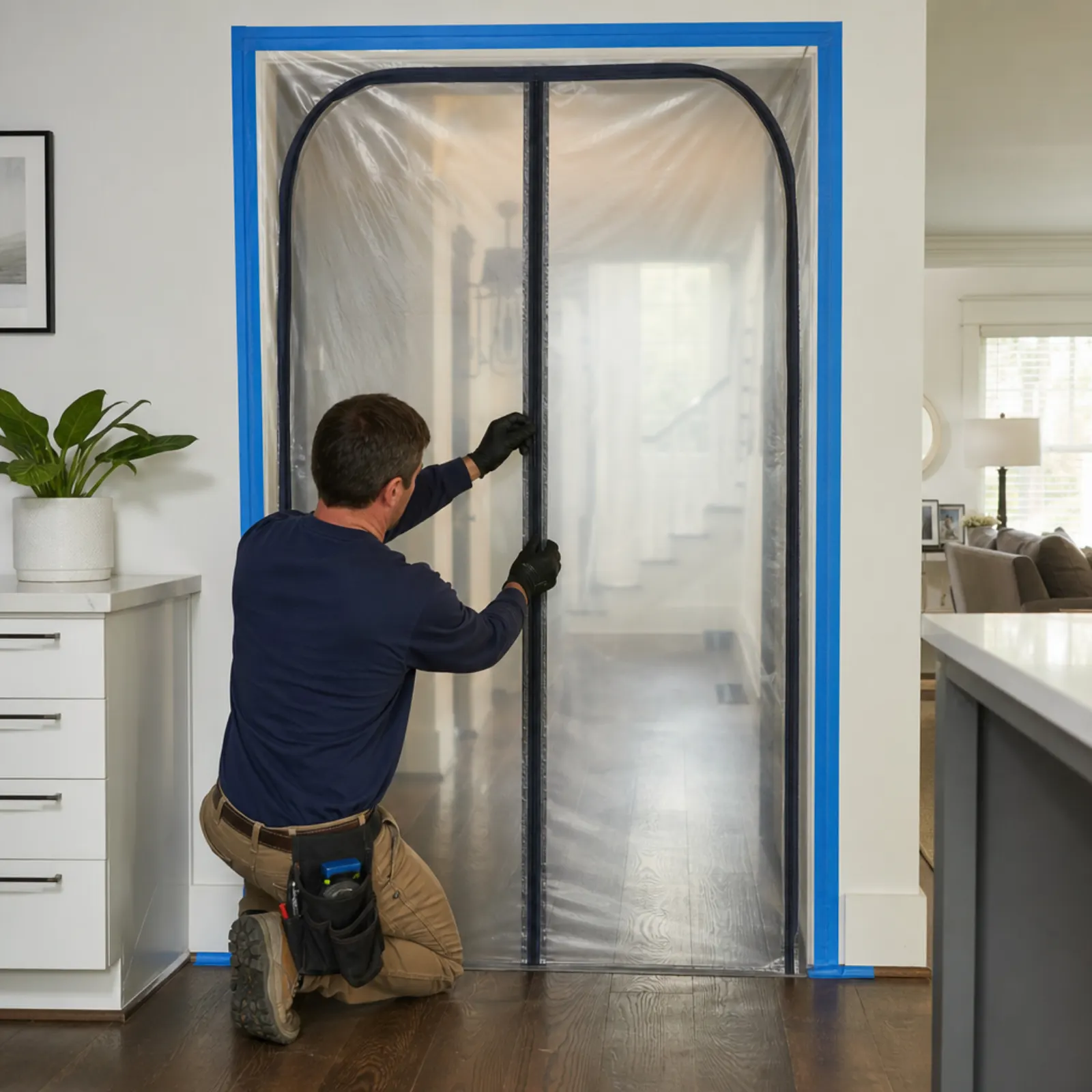
- Full containment, always. Even for small colonies. 6-mil poly barriers, sealed HVAC vents in the zone, covered pathways. No “we’ll just be careful.”
- HEPA-filtered negative air running before, during, and after disturbance, exhausting outside the containment.
- Wet-method removal. Contaminated drywall and materials are misted before cutting to suppress spore release, cut out in manageable sections, and bagged inside the containment for disposal.
- Framing remediation. Studs and plates get HEPA-vacuumed, cleaned, abrasively treated where growth penetrated the surface, and treated with an EPA-registered antimicrobial.
- Independent clearance testing before containment comes down. With Stachybotrys jobs this is non-negotiable. It’s the proof the disturbance stayed inside the plastic.
Occupants with asthma or mold allergies should stay out of the immediate area during work; the containment protects the rest of the home, and we walk you through timing.
Where it turns up in the Northwest Valley
The chronic-saturation requirement means Stachybotrys shows up in predictable places here:
- Behind washing machines and refrigerators in 2000s builds across Surprise Farms, Sierra Montana, and Ashton Ranch, where braided supply lines and saddle valves fail slowly.
- AC closets and platform returns in newer Asante and Marley Park homes, where a clogged condensate line drips into the same drywall for an entire cooling season.
- Under kitchen and bathroom sinks in Sun City West, where original copper develops pinhole leaks that mist the cabinet interior for months, the classic “we thought it was just musty” call.
- Ceiling cavities after monsoon roof leaks, where soaked insulation holds water against drywall for weeks. If your dark ceiling stain appeared after a summer storm, start with the monsoon leak mold page.
- Post-flood baseplates where a water event wasn’t professionally dried, the strongest argument for fast water damage cleanup while the wall is still salvageable.
If you just found it: do this, not that
Do: leave it alone, close the door to the room if there is one, and take a photo from a few feet away. Note anything you know about moisture history, when the stain appeared, any past leaks, whether the area ever smells musty. That context is worth more to an inspector than a close-up.
Don’t: scrub it, bleach it, tape a bag over it, or point a fan at it. Scrubbing and bleach kill some surface growth while aerosolizing spores and leaving the colony’s roots in the material, the growth returns, but now the room’s air is worse than before you started. And don’t run the ceiling fan or crank the AC to “air it out” if the growth is near a return vent; that’s how a closet problem becomes a duct problem.
Health note, kept honest: mold, black or otherwise, can aggravate allergies and asthma. If someone sensitive lives in the home, keep them out of the affected room until it’s contained. Beyond that, symptom questions belong with your doctor, not a contractor with a quote in hand.
The bottom line
Black mold deserves respect, not panic, and definitely not panic pricing. Get the moisture source identified, get the colony removed under real containment by a crew that can show IICRC certification, and get clearance results that prove it’s gone. We take requests across Surprise, Waddell, Sun City West, Goodyear, and Buckeye. Attach a photo of what you’re seeing to your quote request so we see it before calling you.
Frequently Asked Questions
How do I know if it's really black mold?
You can't tell by color, dozens of common molds look black, including Cladosporium and Aspergillus species that show up in Arizona bathrooms constantly. Only lab analysis of a surface sample identifies Stachybotrys. Sampling runs $35–$100 in lab fees, or you can skip the test and remediate properly either way.
Does black mold cost more to remove?
It shouldn't. The S520 process (containment, negative air, removal, clearance) is the same regardless of species, so the price is driven by the size of the contaminated area, not the scariness of the name. A company charging a 'black mold premium' for the same containment and removal is charging for fear.
Is black mold dangerous to my family?
Mold, including black mold, can aggravate allergies and asthma, and nobody should live with an active colony regardless of species. But the toxic-black-mold panic is mostly marketing. The rational response is the same for any indoor mold: fix the moisture, remove the growth under containment, verify with testing.
Can I remove black mold myself?
For a patch under about 10 square feet on a non-porous surface, careful DIY with proper precautions is defensible. On drywall or wood (where Stachybotrys usually lives, since it feeds on wet cellulose) disturbing it without containment releases massive spore loads into your air. That's when professional containment earns its cost.
Why does black mold keep coming back in my shower?
Recurring dark growth on grout or caulk is usually surface mildew feeding on soap film and humidity, an annoyance, not a remediation job. But if it's coming through the caulk or drywall softens when pressed, water is moving behind the tile, and that's a valve or membrane leak feeding real growth in the wall.